
The project :
At a Glance
Embedded with professional auto haulers to understand real-world transport workflows and decision-making under pressure
Conducted in-cab ride-alongs to observe how drivers evaluate loads, routes, and profitability in motion
Identified trust breakdowns between carriers, brokers, and shippers — especially around load accuracy and expectations
Analyzed support data and survey insights to uncover patterns in disputes, ratings, and documentation friction
Brought field insight into product discussions to better align the platform with real driver behavior and marketplace dynamics
The project itself :
Project Overview
Central Dispatch is a marketplace that connects carriers, brokers, and shippers to coordinate vehicle transport across the country. While the platform enables load finding and matching, the real work happens in motion - where professional drivers make logistics decisions based on time, fuel, route efficiency.
My work focused on understanding how drivers actually evaluate and accept loads while on the job, where safety is key, and how system assumptions diverge from real-world data. Through field immersion and workflow analysis, I helped reframe product functionality around the realities of auto hauling logistics and load acquisition from behind the wheel of a semi-truck.
Problem:
The platform effectively supported load discovery, but critical friction emerged once loads moved from listing to execution:
Load information did not always reflect real vehicle condition or requirements
Trust between carriers, brokers, and shippers was inconsistent and often reactive
Workflow assumptions did not account for how decisions are made in motion As a result, drivers absorbed risk in the form of time loss, fuel cost, and route disruption, while support teams handled the fallout through disputes and manual intervention.
Goal:
Understand how professional auto haulers evaluate loads in real-world conditions
Identify patterns in trust breakdowns across carriers, brokers, and support teams
Reduce friction caused by incomplete or inconsistent load information
Improve alignment between the platform and in-motion decision-making
My role:
Senior UX / Product Designer focused on field immersion, workflow validation, and translating real-world insight into product direction.
Responsibilities:
Conducted in-cab ride-alongs with professional auto haulers across multi-state routes
Observed load evaluation, acceptance, and routing decisions in real time
Interviewed carriers, brokers, and internal support teams
Analyzed survey and support data to identify recurring friction patterns
Brought field insight into product discussions to challenge assumptions and guide direction
All about the user :
User Research
This work went beyond interviews and surveys. I spent time in the cab with professional auto haulers, observing how decisions were made while managing real constraints - fuel cost, route sequencing, timing, weather, and regulatory limits.
Drivers evaluated loads based on more than price. They considered:
Route compatibility and deadhead miles
Pickup and delivery timing
Impact on existing load sequence
Risk of inaccurate vehicle descriptions
Likelihood of payment or dispute issues In parallel, internal survey data revealed recurring friction around ratings, documentation, duplicate postings, and dispute handling — reinforcing what was observed in the field.
Drivers evaluated loads based on more than price. They considered:
Route compatibility and deadhead miles
Pickup and delivery timing
Impact on existing load sequence
Risk of inaccurate vehicle descriptions
Likelihood of payment or dispute issues In parallel, internal survey data revealed recurring friction around ratings, documentation, duplicate postings, and dispute handling — reinforcing what was observed in the field.
Pain Points
Behind the wheel decision-making and safety constraints
Drivers weren’t sitting at a desk evaluating loads. They were doing it while operating a truck — often on the highway — balancing attention between the road and a mobile device. This created real safety risks and forced quick decisions without full context. The system didn’t fully account for how load evaluation actually happens — in motion, under pressure, and with limited time to process details.
Reactive trust systems
Ratings and dispute handling relied heavily on manual intervention, creating inconsistent enforcement and frustration across users.
Workflow mismatch
Platform assumptions favored static, desk-based workflows, while drivers made critical decisions in motion under time and safety constraints.
User Profiles
Drivers find and negotiate load acquisition while driving, not from a desk.
Professional Auto Hauler Role: Carrier / owner-operator Goals
Keep the truck full
Maximize profitability across routes
Avoid surprises after accepting a load Frustrations
Incomplete or misleading load details
Weak trust signals
Systems that don’t reflect real driving constraints
Broker / Dispatcher Role: Coordinates loads between shippers and carriers Goals
Match loads efficiently
Minimize disputes
Maintain strong relationships Frustrations
Duplicate postings
Weak enforcement mechanisms
Manual coordination outside the system
Internal Support / Operations Role: Handles disputes, documentation, and trust breakdowns Goals
Resolve issues quickly
Reduce support volume
Maintain marketplace stability Frustrations
High volume of preventable issues
Inconsistent documentation
Reactive workflows driven by system gaps
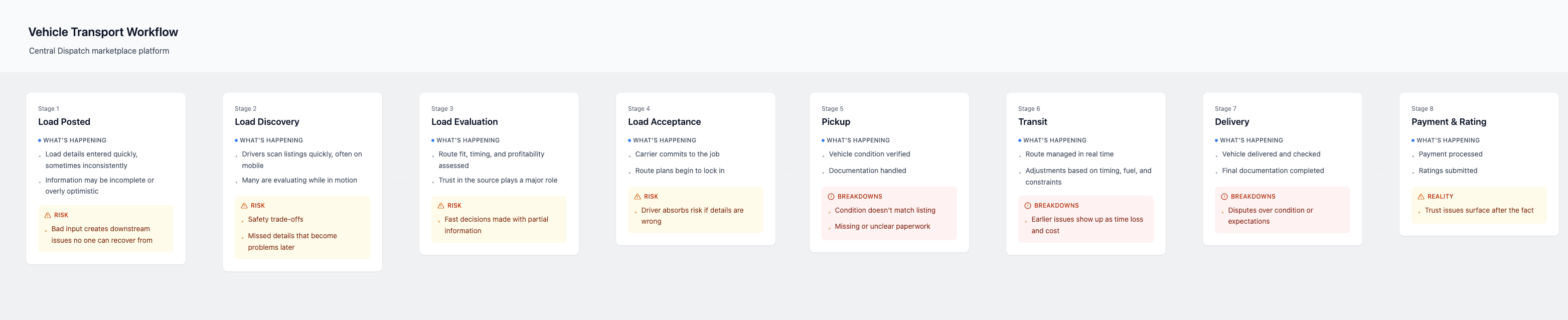
User Journey Map
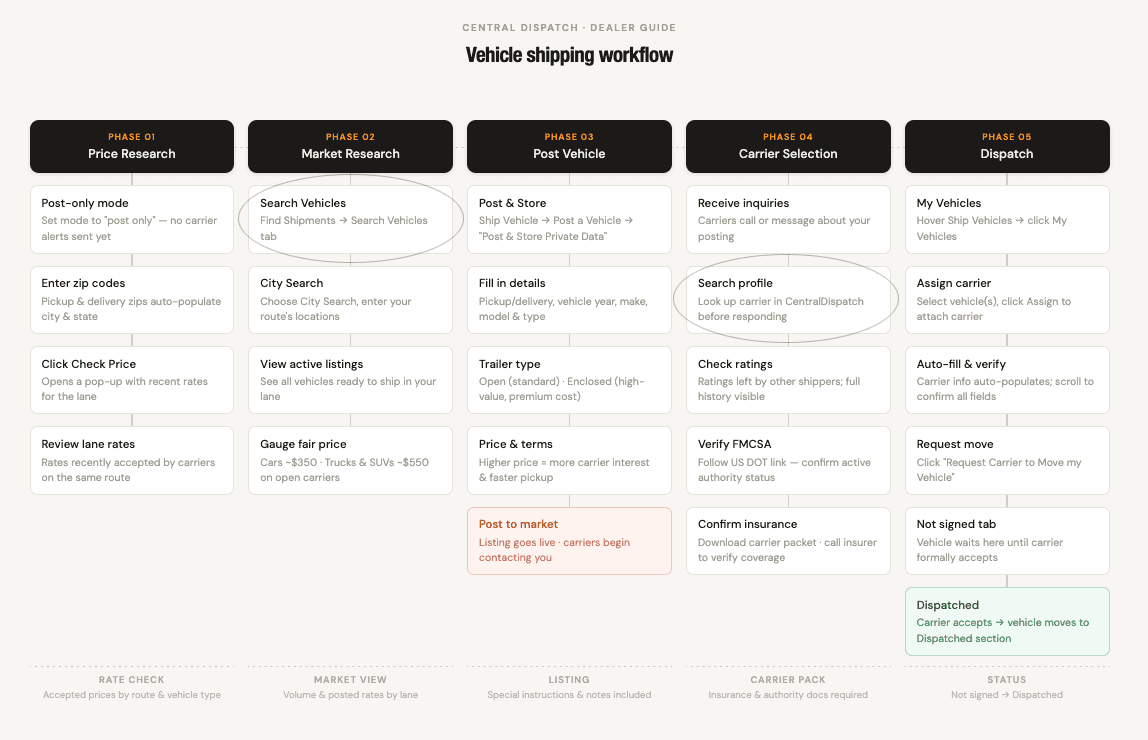
The workflow behind vehicle transport looks simple on paper — post a load, match a driver, move a car. That’s not how it actually works. This journey map is based on what I observed in the field — riding along with professional auto haulers, watching how they evaluate loads, adjust routes, and make decisions while managing real constraints. Most of those decisions weren’t happening at a desk. They were happening in motion — on highways, in traffic, and between pickups. Drivers weren’t just choosing loads. They were balancing safety, timing, fuel, and risk — often while holding a device or glancing at a screen when they shouldn’t have to. What stood out quickly was this: the system assumed attention. The job required movement. This map breaks down where those assumptions start to fail — and where small gaps in information turn into real consequences on the road.
Goal
Create a safer, more reliable way for drivers to interact with the platform — one that respects the reality of how work gets done in motion. That meant reducing reliance on handheld interaction and moving toward a system that could communicate with drivers through voice — allowing them to evaluate loads, receive updates, and make decisions without taking their attention off the road. The goal wasn’t just efficiency. It was safety, trust, and giving drivers a way to stay focused on driving while still staying connected to the marketplace.
The project schematically :
Outcome
This work changed the conversation from how the platform looked to how it actually held up in the real world. By getting into the truck and seeing how professional auto haulers evaluated loads in motion, it became clear that the biggest issues were not cosmetic. They showed up where trust, timing, accuracy, and safety mattered most.
Takeways
The series of hand-drawing frames that visually describe and explore a user's experience with a product.
Impact:
This work brought real driver behavior into product conversations that had been too easy to keep theoretical. It clarified how weak load details, reactive trust systems, and desk-based workflow assumptions created real cost for carriers and avoidable support burden for the business. More importantly, it pushed safety higher in the conversation by showing that drivers were often forced to interact with the system in situations where they should have been focused on the road.
What I learned:
The biggest lesson was that marketplace success is not just about volume or access to loads. It depends on whether the system respects how people actually work. Once I saw how drivers made decisions in motion, it changed how I thought about trust, timing, and usability. Good product decisions come faster when you stop guessing and go stand where the work is happening.
Next Steps
The series of hand-drawing frames that visually describe and explore a user's experience with a product.
Improve how load information is surfaced so drivers can make faster, safer decisions without digging through incomplete details or second-guessing the post.
Move toward voice-based and conversational workflows that let drivers stay connected to the marketplace without relying on handheld interaction while driving.