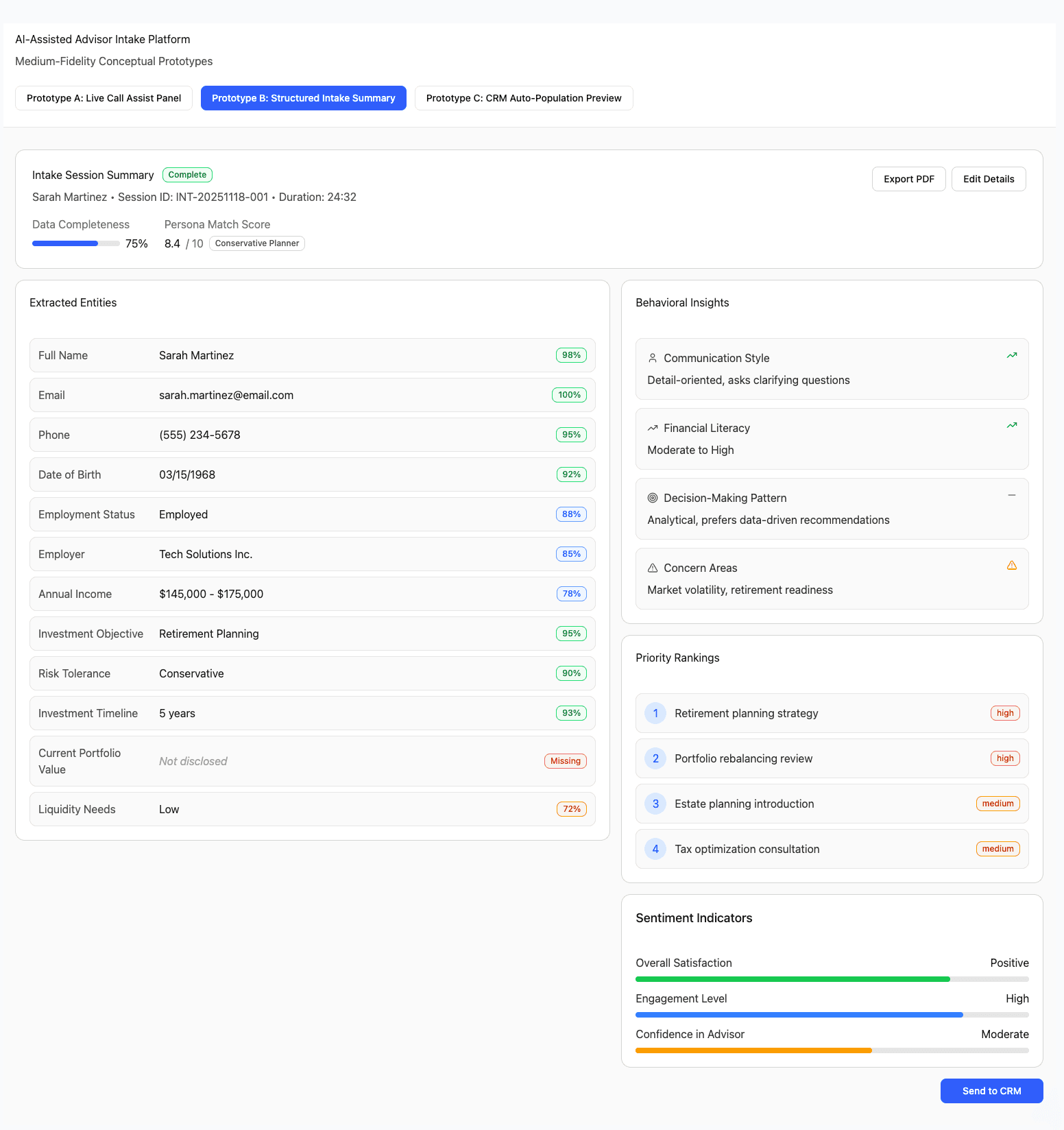
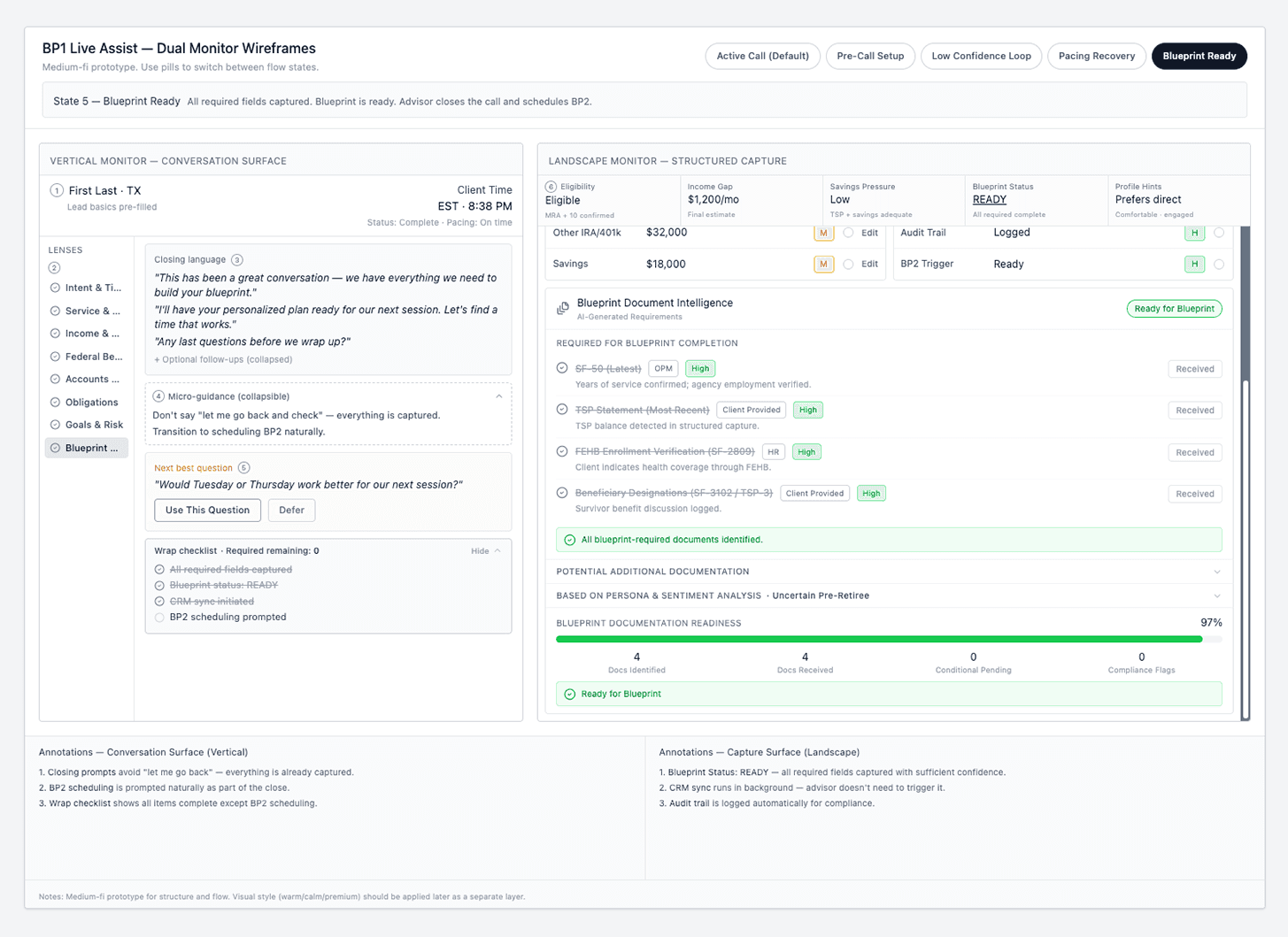
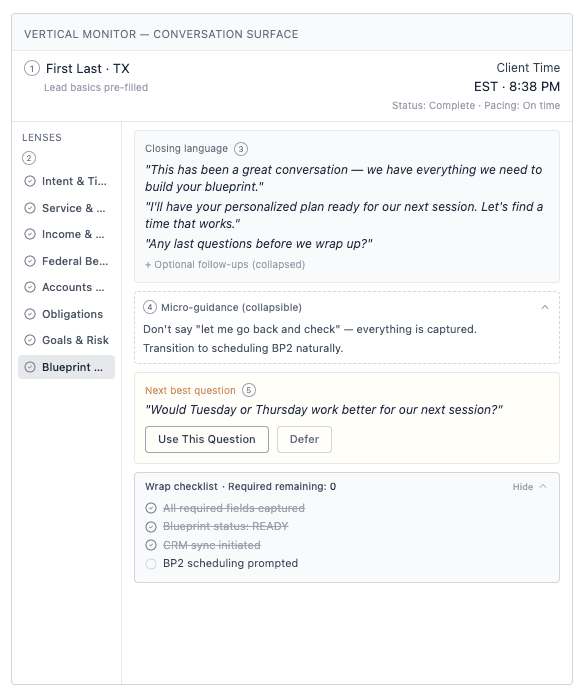
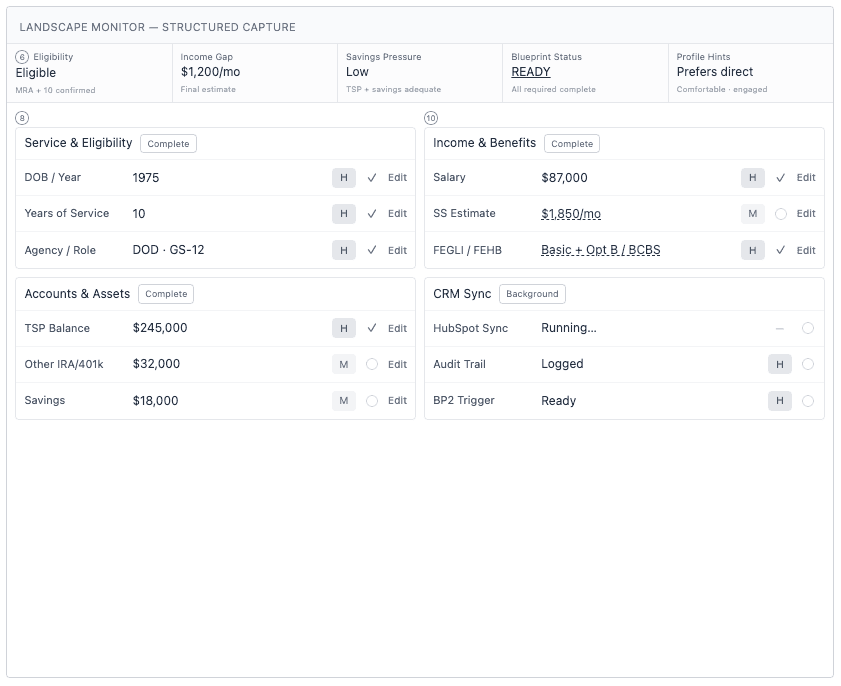
The project:
Project Overview
Blue Monarch contracted me to architect a system-level transformation of how advisors, clients, and back-office teams move together through the retirement planning process. Teams were operating across fragmented tools and manual workflows that increased friction, slowed decision-making, and introduced inefficient data capture and risk when handling sensitive client information. This work focused on modernizing the operational ecosystem, clarifying ownership and communication across time, and designing a trust-based client journey that extended beyond the first meeting. The outcome was a more coordinated advisor operating model, supported by clear frameworks, system-driven communication that reduced manual effort while maintaining human relationships.
Problem:
Blue Monarch was operating across fragmented systems that slowed advisors down, increased operational friction, and introduced risk in handling sensitive client information. Disconnected tools and manual handoffs created inconsistent client experiences, unnecessary rework for back-office teams, and limited visibility for leadership.
Goal:
Modernize the operational ecosystem with secure, compliant tooling that would scale
Reduce friction between advisor and back-office workflows
Establish a repeatable, trust-building client journey beyond the first meeting
Lay a foundation for future AI-enabled efficiency without compromising data privacy Led discovery across leadership, advisors, and back-office teams
My role:
Senior UX/Product Design Consultant acting as a transformation lead and strategic design partner. I owned discovery, system strategy, framework design, stakeholder alignment, and the creation of scalable design and workflow artifacts.
Responsibilities:
Led discovery across leadership, advisors, and back-office teams
Defined ecosystem migration strategy and governance principles (Zero Trust–aligned)
Designed the CLS Framework (Connect, Learn, Strengthen) for post-meeting client trust building
Created workflow and journey maps
Facilitated cross-functional alignment across product, backoffice and advisors
the user :
User Research
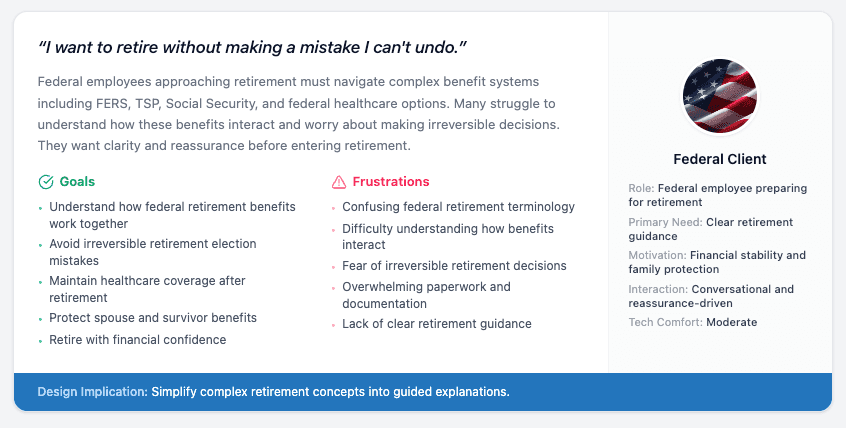
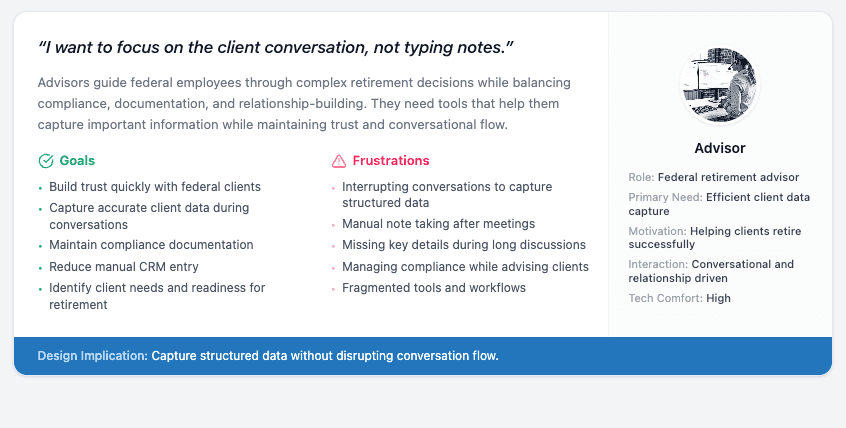
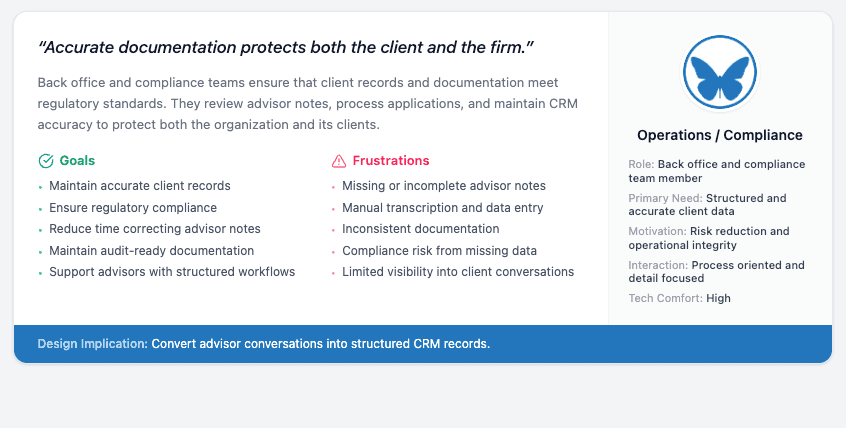
To understand where friction and risk existed, I conducted discovery sessions and interviews with advisors, back-office staff, and leadership. Research focused on real workflows, handoffs between teams, and moments where sensitive client information was collected, transferred, or reworked. The research emphasized day-to-day behaviors: how advisors prepared for client conversations, how back office teams processed documentation, and how leadership monitored progress and accountability. These insights informed both the system redesign and the CLS (Connect, Learn, Strengthen) client journey framework.
Pain Points
Fragmented workflows
Advisors and back-office teams worked across disconnected tools, making it difficult to maintain a single source of truth. Information was duplicated, lost, or manually re-entered, increasing cognitive load and operational risk.
Inconsistent client follow-through
After initial meetings, there was no standardized system to guide advisors and clients through next steps. This led to uneven client experiences and weakened trust during critical decision-making phases.
Sensitive data handling risk
Highly personal client information was collected and transferred through manual or loosely governed processes. Teams lacked clear standards for redaction, access control, and accountability, increasing compliance and security concerns.
Roles in the Retirement Planning Process
Finding Value
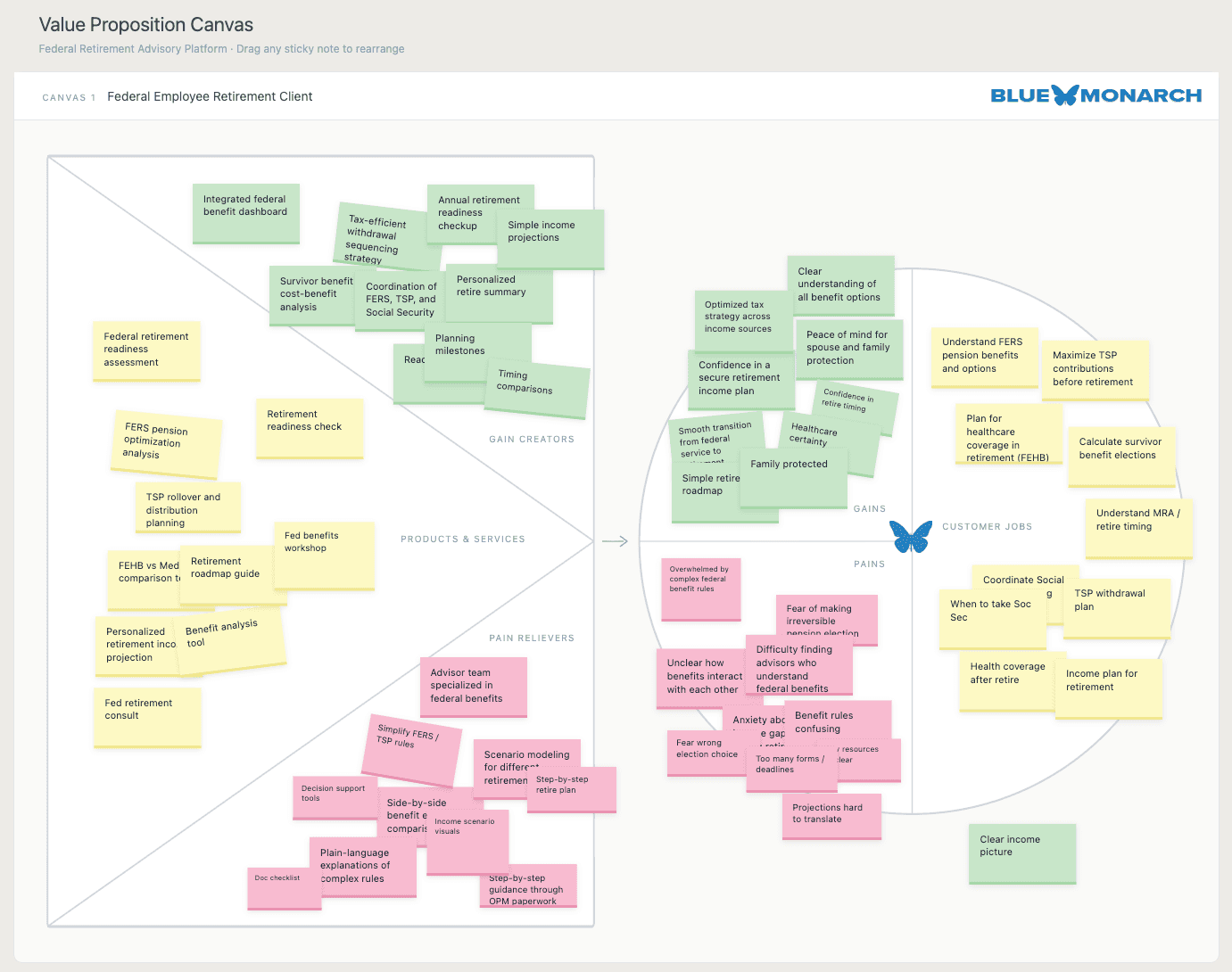
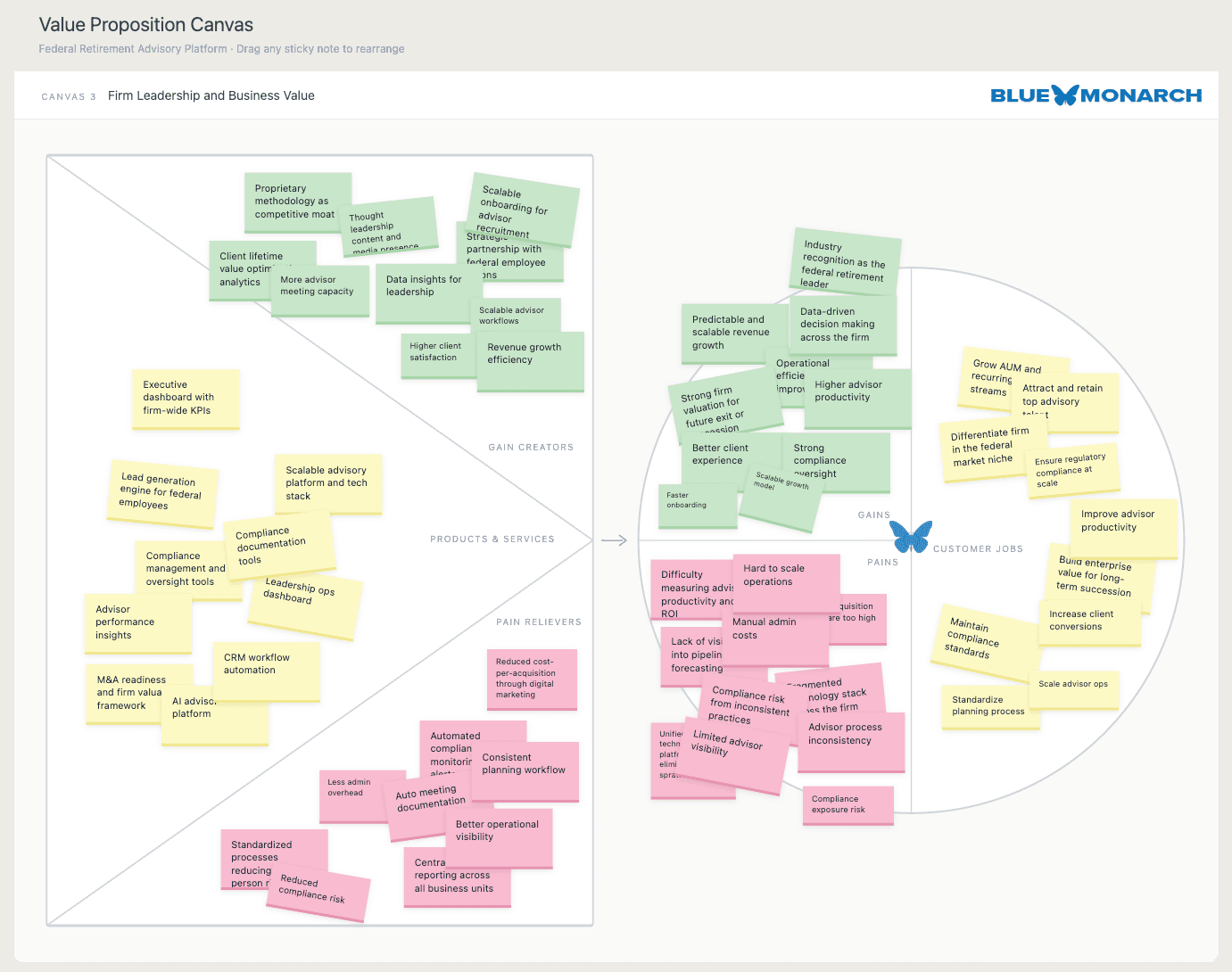
The project :
Starting the Design
Rather than starting with screens, I began by designing the system that would support advisors and clients over time. The early design work focused on clarifying workflows, responsibilities, and communication patterns across the retirement planning journey — especially where timelines, dependencies, and sensitive information intersected.
I created ecosystem diagrams, workflow maps, and framework documentation to align stakeholders on how work should move through the system before introducing interface-level decisions. This approach ensured that any future UI or content delivery would reinforce trust, reduce manual effort, and scale consistently across advisors.
Design decisions at this stage prioritized:
Clear ownership and handoffs
Timeline-driven communication and reminders
Reduction of advisor manual follow-up
Secure handling of sensitive client information
Only after these foundations were established did visual and interaction considerations come into play.
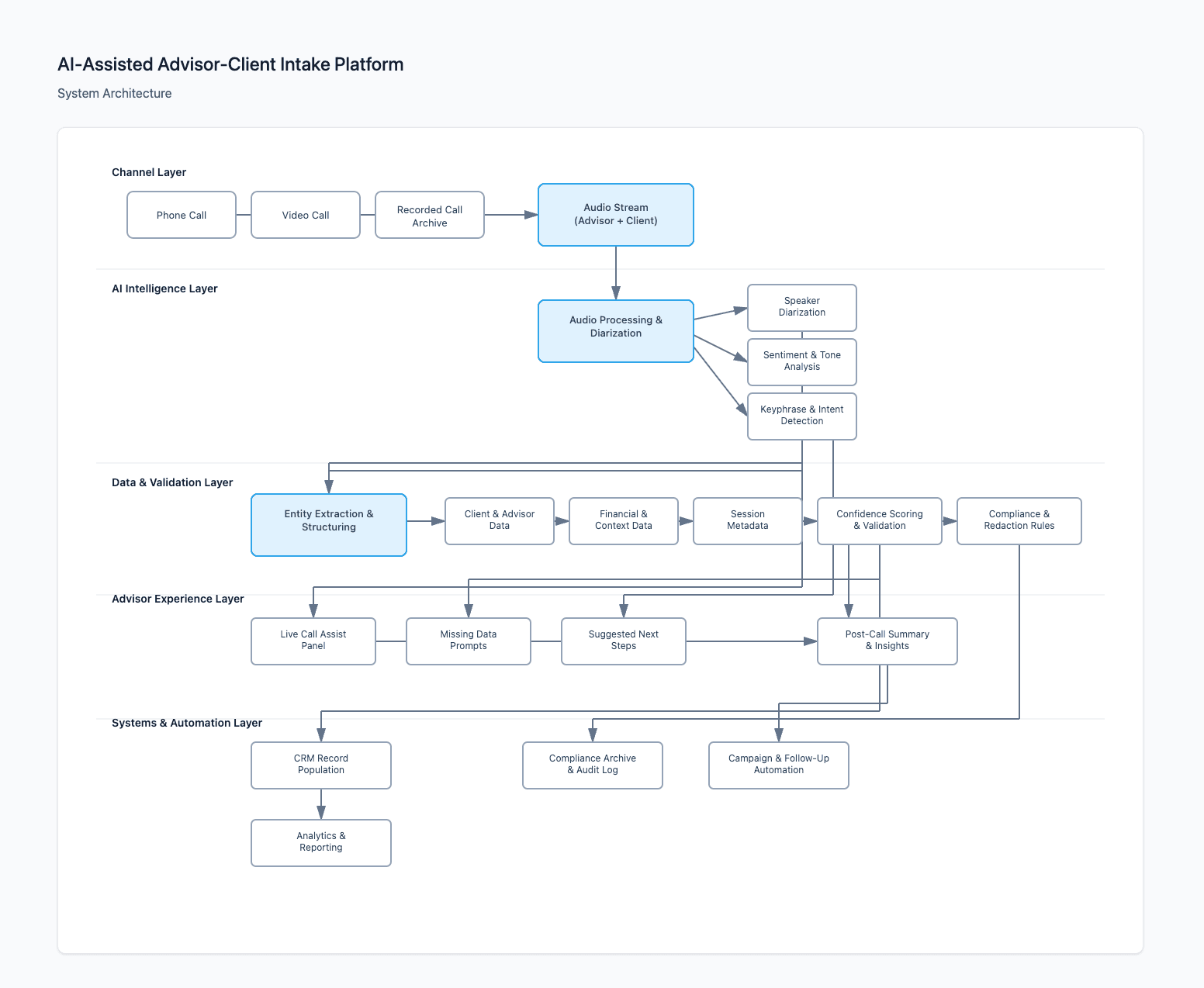
System Map
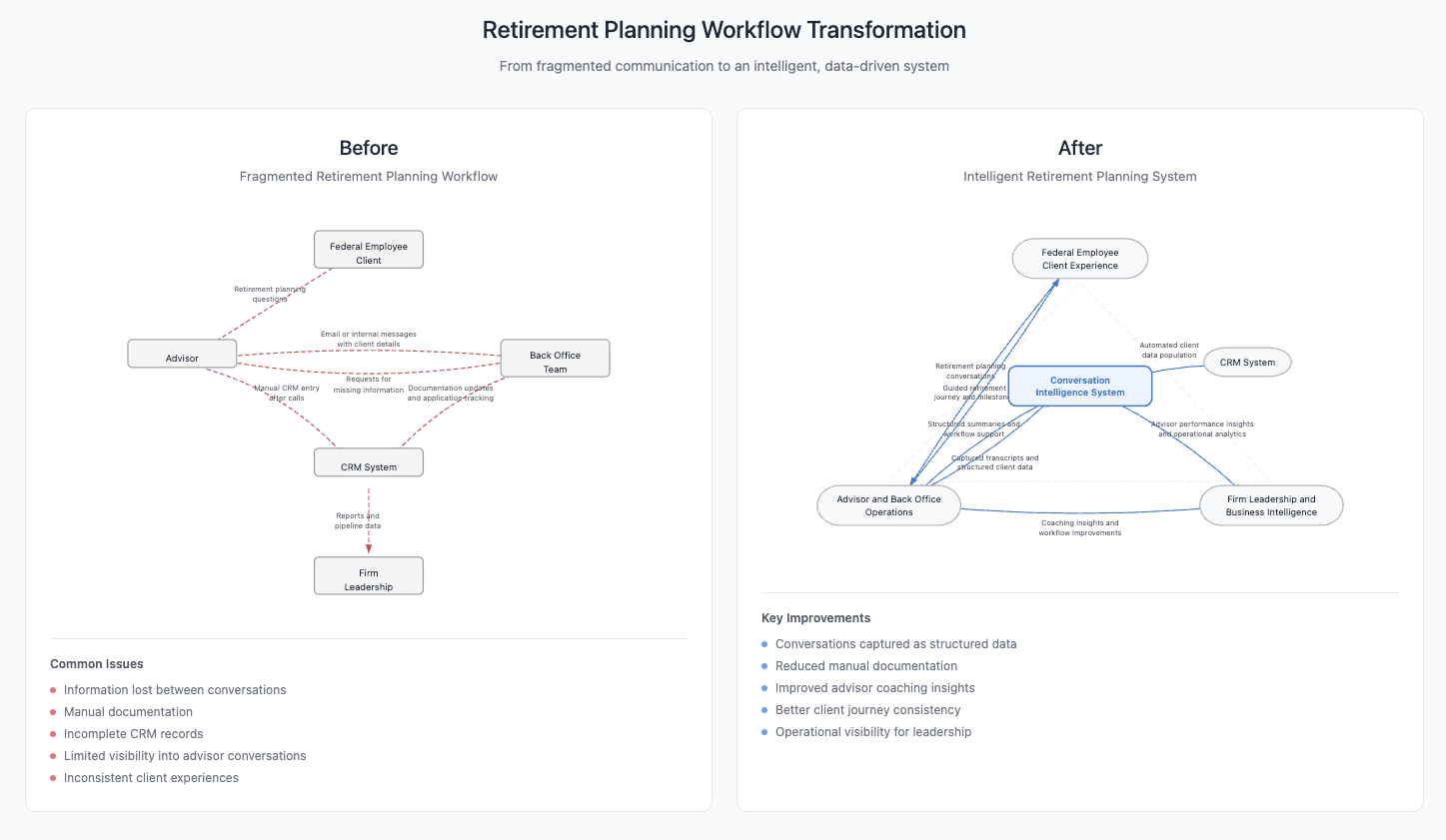
For Blue Monarch, this map represents a system-level architecture rather than a single interface. I mapped how tools, workflows, and communication layers interact to support advisors throughout the retirement planning journey—focusing on ownership, data flow, and timing rather than screens. The map clarified how advisors move between systems while guiding clients, how information is captured and validated, and where automation could replace manual follow-ups without compromising trust or compliance. Key elements of the system included:
A centralized CRM as the source of truth for client status and progress
Communication layers that trigger reminders, expectations, and educational content based on journey stage
Workflow alignment between advisor-facing activities and back-office processing
Governance boundaries to protect sensitive client information and control access
Interview Findings
Validation focused on real-world feasibility, adoption risk, and operational clarity across advisors, back-office teams, and leadership. The goal was to ensure the system and frameworks supported how work actually happens—under time pressure, compliance constraints, and ongoing client relationships. Validation activities included:
Scenario walkthroughs with advisors to test workflow clarity across key client milestones
Stakeholder reviews to pressure-test handoffs, ownership, and edge cases
Operational reviews with back-office teams to identify rework risks and missing inputs
Iterative feedback loops to refine communication timing, expectations, and system triggers
These studies helped surface friction points that wouldn’t appear in isolated interface testing—such as unclear accountability, inconsistent follow-through, and gaps between advisor intent and system behavior.
Clarifying post-meeting expectations
Early walkthroughs showed that clients often left initial meetings unclear on what was expected next, even when advisors explained it verbally. This created delays and additional follow-up work.
Refinement: Standardized post-meeting communication was introduced to reinforce expectations, timelines, and required actions—reducing advisor-driven follow-ups and improving client responsiveness.
Reducing manual advisor follow-ups
Scenario testing revealed that advisors were spending significant time chasing documents and status updates that could be automated without losing trust.
Refinement: System-triggered reminders and status visibility were incorporated through the CRM, allowing clients to see what was needed while giving advisors confidence that progress was being tracked consistently.
Improving advisor-client alignment
Stakeholder reviews surfaced gaps between advisor intent and system behavior—particularly when responsibilities shifted between advisor, client, and back-office teams.
Refinement: Clear ownership and handoff rules were established within workflows, ensuring that advisors, clients, and operations teams shared the same understanding of next steps at each stage of the journey.
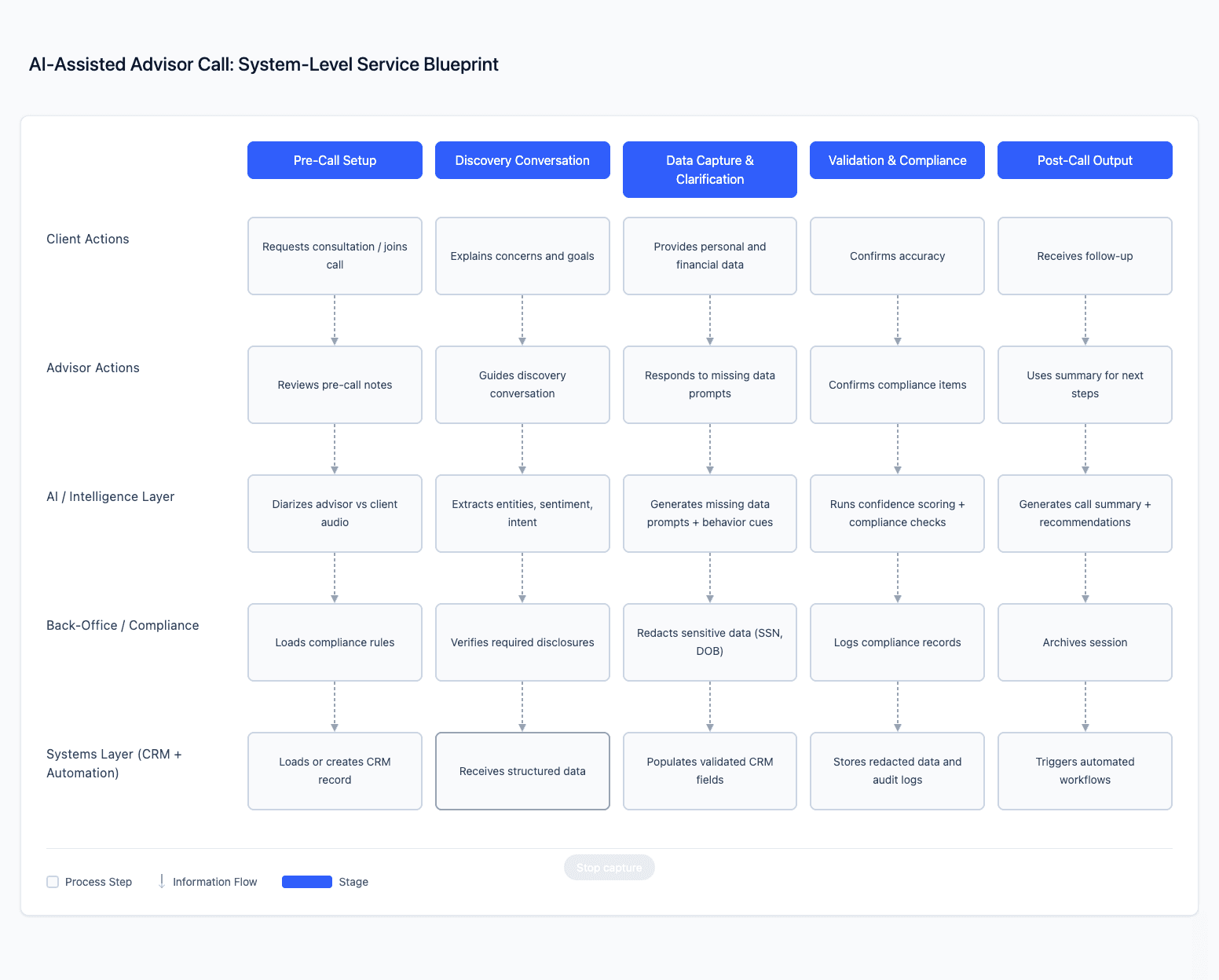
Journey Overview
I mapped the advisor-led journey to understand how advisors guide clients through the retirement planning process over time, where communication and documentation break down, and how systems can proactively support teams. The journey reflects a hybrid model — advisor-centric, but dependent on timely client participation where clarity, communication of expectations are critical to maintaining momentum and trust.
Goal
Enable advisors to move clients through retirement planning milestones with confidence and consistency, while reducing manual follow-ups by using system-driven communication.
The project :
Outcome
The work resulted in a clearer, more coordinated operating model for how advisors, clients, and back-office teams move through the retirement planning journey. By focusing on system behavior rather than isolated interfaces, the organization gained consistency, reduced friction, and created a foundation for scalable growth.
Key outcomes included:
Improved advisor efficiency
Advisors spent less time managing follow-ups, clarifying expectations, and tracking progress across disconnected tools. System-driven communication and clearer workflows reduced cognitive load and manual effort.
More consistent client experience
Clients received clearer guidance on what was expected, when actions were required, and who was responsible—reducing uncertainty and improving trust throughout the process.
Stronger operational alignment
Back-office teams received more complete and contextualized inputs, reducing rework and late-stage corrections. Ownership and handoffs became easier to understand and enforce.
Reduced risk in sensitive data handling
Governance and workflow refinements improved clarity around access, responsibility, and information flow—supporting compliance expectations without slowing teams down.
Scalable foundation for future growth
The ecosystem modernization and CLS framework established reusable patterns, templates, and standards that could support additional advisors, clients, and future automation initiatives. While not all outcomes were instrumented with quantitative metrics at the time of delivery, success was validated through stakeholder alignment, adoption readiness, and a measurable reduction in known friction points identified during discovery.
Takeways
Impact:
This work reinforced how much leverage exists in designing systems that coordinate people, timing, and expectations—especially in regulated, trust-driven environments. By shifting focus away from isolated tools and toward system behavior, the organization gained greater consistency, reduced friction, and improved advisor confidence without increasing process overhead. The project demonstrated that meaningful experience improvements don’t always come from new interfaces. In many cases, the most valuable impact comes from clarifying ownership, aligning communication, and letting systems absorb repetitive work so humans can focus on relationships.
What I learned:
Designing for trust requires designing for time, not just moments
• Reducing cognitive load is often more valuable than adding flexibility
• Validation is most effective when it pressure-tests real workflows, not idealized scenarios • Systems that support advisors must reinforce—not replace—the human relationship
• Clear structure early enables better judgment and adaptation later
This project strengthened my conviction that UX work is oftentimes, less about artifact production and more about shaping behavior, coordination, and decision-making across complex systems.